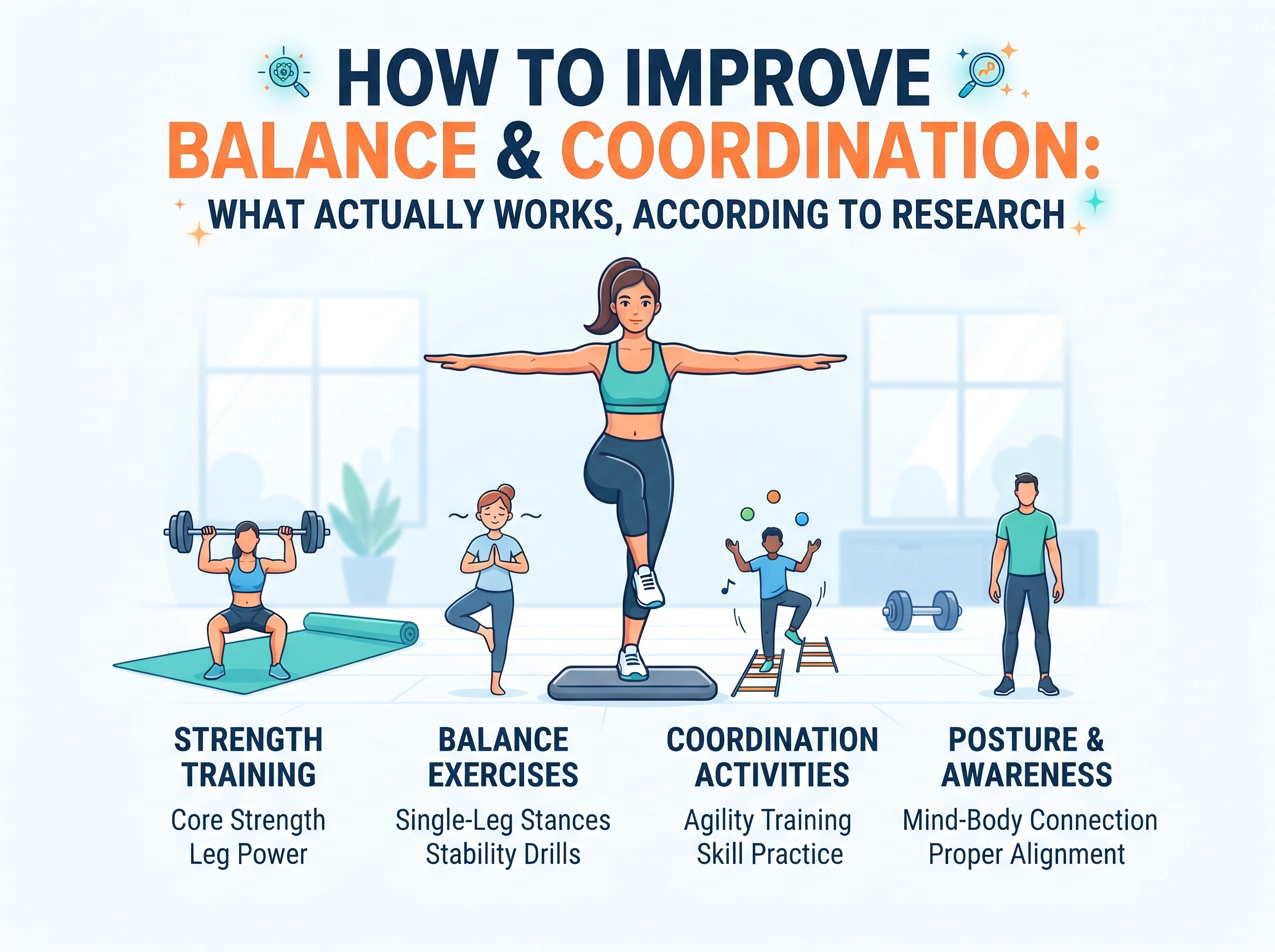
Feeling unsteady on uneven ground, missing a step, or struggling to catch an object aren't just "getting older" problems; balance and coordination are highly trainable motor skills at virtually any age. This guide breaks down how to improve balance and coordination using the same evidence-based framework physical therapists and clinical researchers rely on: understanding your body's sensory systems, performing exercises with exact form, and applying structured progressive overload.
What Are Balance and Coordination, and Why Do They Decline?
To train balance effectively, it helps to understand how your brain maintains stability:
· Static Balance: Your ability to maintain control over your body's center of mass over a fixed base of support while remaining still (e.g., standing on one leg).
· Dynamic Balance: Your ability to maintain stability while moving or shifting your weight (e.g., walking on gravel, climbing stairs, or changing direction).
· Coordination: The smooth integration of multiple muscle groups and sensory inputs to execute precise movements (e.g., catching a falling object or stepping over an obstacle).
Your nervous system relies on three distinct sensory systems to maintain posture and balance:
1. The Visual System: Uses visual cues from your surroundings to orient your position in space.
2. The Vestibular System: Sensory receptors within your inner ear that monitor head orientation, tilt, and acceleration.
3. Proprioception: Nerve receptors located in your muscles, tendons, and joints that communicate limb position to your brain without requiring you to look.
Age-related decline, physical inactivity, joint injury, or certain medications can impair these input systems. Fortunately, targeted neuro-muscular training can recalibrate these pathways and restore stability.
The Core Connection: Why Core Strength Matters for Balance
Clinical studies consistently highlight trunk endurance as a primary foundation for postural control. Your core—comprising the rectus abdominis, obliques, erector spinae, and deep hip stabilizers—serves as the central anchor for movement.
When your foot hits an unexpected bump, a stable core prevents your upper body from swaying excessively out of your base of support. Building endurance in these deep stabilizing muscles enhances dynamic balance and refines proprioceptive feedback in the hips and shoulders. For a comprehensive breakdown of core routines, explore our guide on core exercises for balance.
Step-by-Step Balance & Coordination Exercises
To safely execute balance training at home, follow these clinical execution cues for optimal results:
1. Single-Leg Stance (Static Balance & Proprioception)
· How to do it: Stand upright near a sturdy wall or chair. Engage your core, fix your gaze on a stationary point ahead, and lift one foot 2 to 3 inches off the ground. Keep your hips level and avoid leaning into the standing leg.
· Target Duration: Hold for 20 to 30 seconds per leg. Perform 3 sets.
2. Tandem (Heel-to-Toe) Stand (Base of Support Challenge)
· How to do it: Place your right foot directly in front of your left foot so your right heel touches your left toe. Distribute your body weight evenly across both feet.
· Target Duration: Hold for 30 seconds, then switch foot placement. Perform 3 sets.
3. Bird-Dog Drill (Core Stability & Cross-Body Coordination)
· How to do it: Start on all fours with hands under shoulders and knees under hips. Extend your right arm forward while simultaneously extending your left leg straight back until both are parallel to the floor. Keep your spine neutral and hips square.
· Repetitions: Perform 10 to 12 controlled repetitions per side.
4. Reaction Ball & Footwork Drills (Dynamic Coordination)
· How to do it: Toss a multi-faceted reaction ball against a firm wall and catch it on the rebound, or practice rhythmic footwork using an agility ladder flat on the floor.
· Frequency: 5 to 10 minutes per session to sharpen hand-eye and foot-brain response speed.
Balance and Coordination Exercises at a Glance
Exercise Type
Key Examples
Primary Clinical Benefit
Recommended Frequency
Static Balance
Single-leg stance, tandem stand
Refines standing postural control & ankle proprioception
2–3x / week
Dynamic Balance
Heel-to-toe walking, Tai Chi forms
Builds stability during movement and weight transfer
2–3x / week
Core Stability
Planks, Bird-Dog, Dead Bug
Strengthens trunk anchor to prevent excess postural sway
2–3x / week
Reactive Coordination
Reaction ball drills, Agility ladder
Sharpens neuromuscular response speed & hand-eye timing
2–3x / week
How to Progress Safely: The 3-Level Balance Framework
To continually adapt and improve, balance routines must follow a structured progressive overload model. Advance through these levels as your stability improves:
· Level 1 (Foundational): Perform exercises on a firm, flat surface (e.g., hardwood or tile) with hands placed near a sturdy wall or chair for support and eyes open.
· Level 2 (Intermediate): Remove hand support while remaining on a firm surface, or perform static holds while turning your head slowly side to side.
· Level 3 (Advanced): Introduce an unstable surface (e.g., a foam balance pad or rolled towel) or perform holds with eyes closed to rely entirely on proprioceptive and vestibular feedback.
Evidence-Based Balance Exercises for Seniors & Fall Prevention
Fall prevention research emphasizes that multimodal balance training is one of the most effective non-pharmacological interventions available for older adults. Clinical trials evaluated by public health guidelines highlight structured programs such as the Otago Exercise Program and Tai Ji Quan: Moving for Better Balance, which have been shown in meta-analyses to reduce fall incidence by 20% to 58%.
Safety Protocol for Seniors: Always practice near a sturdy countertop or chair, wear supportive flat-soled non-slip footwear, and ensure adequate lighting. Consistency over 12 to 24 weeks is essential for motor pattern adaptation.
Who Should Exercise Extra Caution?
Consult a medical professional or physical therapist before starting a new routine if you have any of the following conditions:
· Vestibular Disorders or Vertigo: Conditions such as BPPV or Meniere's disease require specialized vestibular rehabilitation rather than generic home drills.
· Neurological Conditions: Individuals recovering from a stroke or managing Parkinson's disease require individualized physical therapy.
· Uncontrolled Cardiovascular Conditions: Sudden position changes can trigger orthostatic hypotension or blood pressure fluctuations.
· Severe Osteoporosis or Recent Joint Replacement: Movements must be modified to eliminate fall risk and excessive joint twisting.
Training Frequency: How Often Should You Train?
Meta-analyses on exercise prescription indicate that optimal balance improvements occur with a frequency of 3 sessions per week, lasting 30 to 45 minutes per session. Measurable physiological adaptations typically emerge after 8 to 12 weeks of consistent practice, with sustained long-term benefits appearing at 24 weeks.
The Bottom Line
Balance and coordination respond directly to consistent, progressive training. By incorporating core stability, step-by-step postural drills, and dynamic movement challenges, you can rebuild confidence and motor control.
Ready to build your personalized routine? Explore structured workouts in our Coordination Fitness section, or review our guide on Core Exercises for Balance.
This article is for general informational purposes and isn't a substitute for individualized guidance from a doctor or physical therapist, especially if you have an existing injury, a balance disorder, or a chronic health condition.